On Thursday 30 April, from 10:00 to 13:30, the University of Barcelona (UB) will host the fourteenth UB–Familia Torres Environmental Conference in the Aula Magna of its Historic Building (Gran Via de les Corts Catalanes, 585). The event is jointly organised with Familia Torres and an advisory committee of experts chaired by meteorologist and UB Doctor in Communication, Tomàs Molina. Under the title “Why Do Environmental Policies Generate So Much Controversy?”, the conference will explore growing tensions around climate and environmental policies in a context shaped by geopolitical conflict, the energy crisis and the challenges facing the farming sector.
Opening session and framing the debate
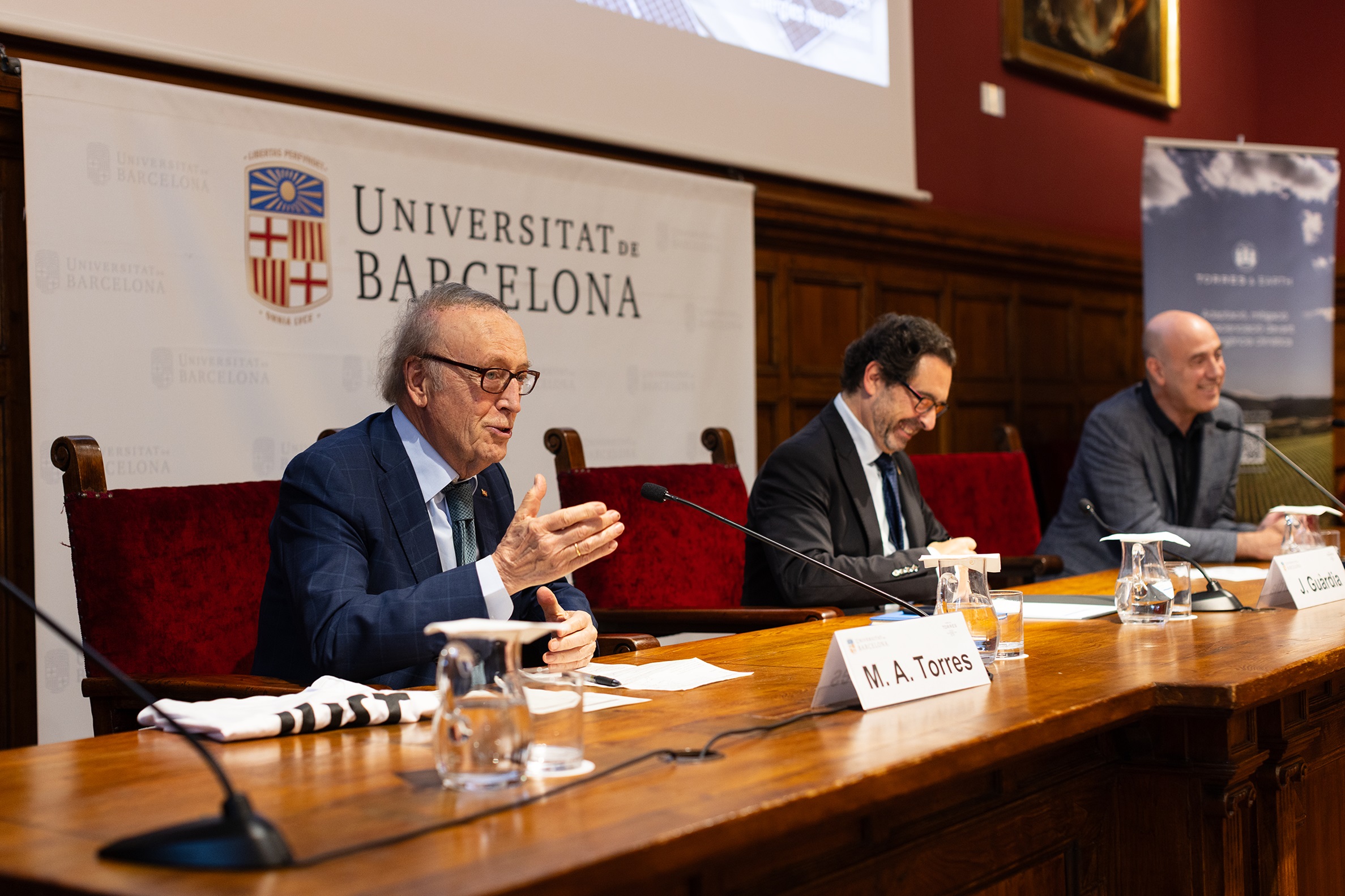
The conference will be formally opened by UB Rector, Joan Guàrdia; President of Familia Torres, Miguel A. Torres; and Tomàs Molina, who will chair the session.
The first address will be given by environmental scientist Marc Vilahur, Director General for Environmental Policies and Natural Environment in the Government of Catalonia. He will reflect on the shift from treating environmental policy as a sectoral issue to integrating environmental considerations across all areas of public policy – one of the key challenges for achieving a genuine transformation of the socio-economic model.
He will be followed by Amaranta Herrero, sociologist and PhD in Environmental Sciences (UAB), Professor of Sociology at the UB and a researcher specialising in socio-ecological conflicts, environmental movements and food governance. Her talk will provide tools for understanding environmental conflicts in a context of “contested sustainability”, in which different actors compete to define what “ecological transition” means and what social costs it entails.
Land-use competition: food, energy and the environment
The second part of the conference will focus on competition for land use within the broader European debate on food security, energy policy and environmental protection.
First, Ricard Ramon, Head of Unit for strategy and the Common Agricultural Policy (CAP) at the European Commission’s Directorate-General for Agriculture and Rural Development, will set out the EU-level debate on how to reconcile food production, the roll-out of renewable energies and ecosystem conservation in European policies.
This will be followed by a round table on land-use competition moderated by Tomàs Molina, with contributions from: Carles Vicente, Head of Environment at Unió de Pagesos de Catalunya; José Donoso, CEO of the Spanish Photovoltaic Union (UNEF); Carolina Pérez, Regional Coordinator for Greenpeace in Catalonia; and Marc Vilahur, Director General for Environmental Policies and Natural Environment (Government of Catalonia).
Exploring the opportunities of the ecological transition
In the final section of the conference, analyst and academic Cristina Monge, Professor of Political Science and Sociology specialising in democratic quality and governance for the ecological transition, and winner of the 2026 Paidós Prize, will deliver a keynote address entitled “The Great Opportunity”. She will focus on the democratic, economic and social opportunities that the ecological transition can generate if it is managed in a fair and participatory manner.
The closing summary will be presented by students from the UB Master’s Degree in Specialised Communication, who will distil the key messages of the day. The official closing remarks will be given by UB Vice-Rector for Sustainability and Climate Action, M. Teresa Sauras-Yera, together with Miguel A. Torres and Tomàs Molina.
Registration and live streaming
The fourteenth Environmental Conference will be streamed live on the University of Barcelona’s YouTube channel. Attendance in person requires prior registration at jornadesambientals.com.