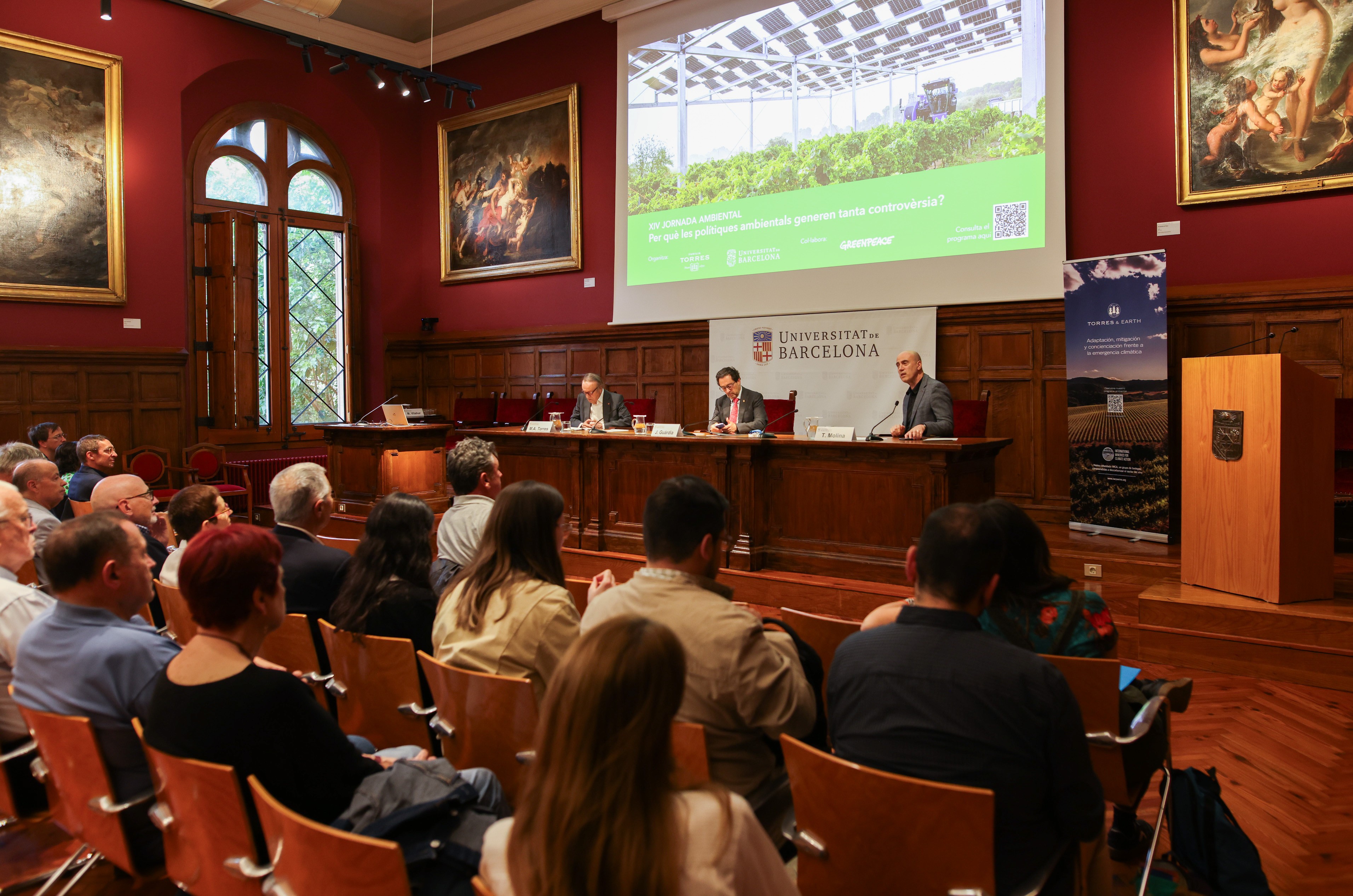
The University of Barcelona has once again hosted the Environmental Conference organised in collaboration with Familia Torres. Now in its fourteenth edition, this morning of talks and debates has focused on environmental policies and the controversies they generate. The topic adds to a series of themes which, in recent years, have explored key issues that will shape our collective future.
In his opening remarks, UB rector Joan Guàrdia called for a move beyond “diagnosis” and “pilot projects” towards concrete action to deliver the energy transition. Acting as moderator of the day, and chair of the expert advisory committee behind the programme, meteorologist and communicator Tomàs Molina highlighted how the Conference brings together scientific and societal perspectives, which often clash, and how this space can help to identify and address those points of friction.
Miguel A. Torres, president of Familia Torres, described himself as a “pessimist”. While acknowledging progress in renewable energies and the electrification of transport, he reminded the audience that oil companies still receive state subsidies despite the current climate emergency and that they are also driving “climate denialism”, which is holding back faster and more ambitious action.
Environmental policies and sources of conflicte
The first keynote address was given by Marc Vilahur, environmental scientist and Director‑General for Environmental Policies and Natural Heritage at the Government of Catalonia, who focused on how environmental and sustainability ideas are translated into public policy. Environmental policies, he argued, are controversial because they involve “real changes”. They require a far‑reaching transformation of habits across all sectors of society – a complexity that must be fully acknowledged. Nevertheless, he concluded, such policies are essential for the survival of our societies as we know them, and this message needs to be clearly communicated and placed at the heart of decision‑making, supported by appropriate scales, indicators and mechanisms to ensure progress.
These environmental policies inevitably give rise to conflicts and debates – the subject addressed by Amaranta Herrero, sociologist, PhD in Environmental Sciences and lecturer at the UB. She began by recalling that social conflicts have historically been drivers of change, and environmental conflicts are no exception. They take many different forms – from urban planning and waste management to extractive activities – but they are always, she said, “a clash between industrialism and environmentalism”. This clash is economic, but above all reflects contrasting world views, leading to situations such as environmental protests against solar farms. It is a struggle in which the same values can manifest in seemingly contradictory ways during a transitional phase. What needs to be understood, she stressed, is that it is impossible to make isolated, local changes while expecting societies to remain exactly the same; society itself must evolve to adapt to the future, through a deep, cross‑cutting transformation.
Joining the event via video message, Ricard Ramon, Head of the Strategy and Analysis of the Common Agricultural Policy (CAP) Unit at the European Commission’s Directorate‑General for Agriculture and Rural Development, addressed the issue of competing land uses. In recent years, he noted, Europe has lost some nine million hectares of farmland, even though overall production has increased thanks to technological improvements. Urbanisation is the main driver of agricultural land loss, followed by land abandonment and reforestation, while energy production adds further pressure. Ensuring food security remains a central priority, and protecting production requires acting “with clarity”. This, Ramon explained, is where the new CAP comes into play: it must “support the farming sector” as it faces new challenges, helping it to remain competitive and adapt to climate change.
A debate with diverse perspectives
With these areas of tension on the table, a round‑table discussion followed. Alongside Marc Vilahur, the panel included Carles Vicente, Head of Environment at farmers’ union Unió de Pagesos, and José Donoso, CEO of the Spanish Photovoltaic Union (UNEF). Despite a shared commitment to the environment and sustainability, the discussion highlighted very different understandings of these concepts, as well as the specific interests of each sector. Donoso noted that, to meet renewable energy targets, it would be enough to devote only about 0.4% of Spain’s agricultural land to solar installations, whereas Vicente drew attention to the significant regulatory hurdles facing energy communities, particularly from the standpoint of the farming sector. All three, however, agreed on the need for greater coherence between discourse and action, particularly in the political sphere, where both the farming and photovoltaic sectors pointed to major inconsistencies. Vilahur responded by arguing for the need to overcome “Cartesian reductionism” and “embrace complexity” in order to integrate the different perspectives and find mutually beneficial solutions.
A positive Outlook
The final part of the Environmental Conference began with a talk by Dr Cristina Monge, analyst and lecturer in political science and sociology, specialising in the quality of democracy and governance for the ecological transition, and winner of the 2026 Paidós Prize. Continuing the day’s debate, Monge emphasised that science clearly shows change is both necessary and urgent. The key question, she said, is how to bring about that change. Differences arise from the complexity and depth of the transition, from the way it affects power relations and from the ideological divergences between the various actors involved and their competing proposals for the energy transition. Moreover, the climate crisis represents “a major threat” to democracy itself. Yet, she concluded, this context also creates a significant opportunity to develop solutions that strengthen social justice, put people at the centre, adopt a truly global outlook and, in doing so, help to reduce inequalities.
To close the conference, Tomàs Molina and Miguel A. Torres, together with Teresa Sauras‑Yera, Vice‑Rector for Sustainability and Climate Action at the UB, thanked speakers and attendees for a morning of intense and thought‑provoking discussions which, once again, have offered an informed and plural look at an increasingly urgent issue that affects us all.