
The Sounds of Winter in the Vineyard
By Jose Luis Gallego, environmental communicator (@ecogallego)
On a frosty January morning, while the farmer organizes his tools in the vineyard shed, an unmistakable sound makes him stop and step outside. Gazing at the sky, he remarks, “Another year, and here they are again.” Crossing the grey sky is a flock of cranes, flying in their customary V-formation, whose presence marks the harsh passage of winter in the rural world.
The lapwings also arrived a few days ago, fleeing the snow that is beginning to blanket their breeding grounds in northern Europe. For years, these birds, easily recognizable by their distinctive silhouette, have helped people in rural areas, especially those who work the land, to predict the harshness of the coming winter. Their name in Spanish – avefría or “bird of the cold” – evokes this traditional role. People make their predictions based on when and in what numbers they arrive and settle among the frosty stubble of the fields or fallow land.
However, besides the calls of migrating birds, the vineyards have another protagonist on winter days that rarely makes an appearance in spring or summer: silence. Without the trill of summer songbirds, the croaking of frogs or humming of insects, winter ushers in a time of peace and quiet in the vineyards. That said, it is – as is always the case in nature – a resounding silence.

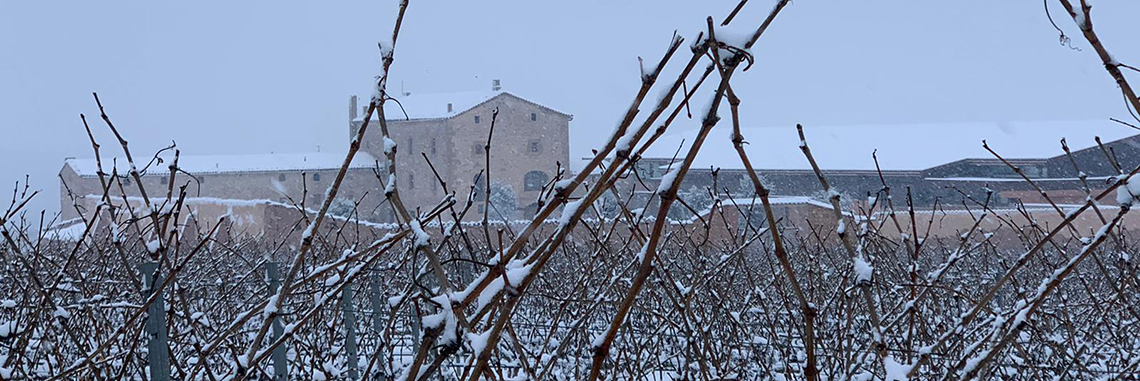
Snow in the Familia Torres vineyards in Tremp, winter 2021
Much like the owners of stately homes cover their furniture during long absences, nature spreads a white sheet of snow over the landscape during the coldest months of the year. This muffles the sounds of wildlife, which has opted for a good long hibernation. A comfortable and restful time beneath the snow. Contrary to what many readers might think, snow provides shelter for the animals that live in the wild.
Nestled into its burrow beneath a white wintry blanket, a hare can enjoy temperatures up to ten degrees higher than it would out in the open. Furthermore, as any hiker knows, the worst enemy of hot-blooded creatures in winter isn’t the cold but the wind. Sleet storms multiply the wind chill, driving icy pellets that cause the skin to burn and breath to freeze. By contrast, below the snow, the temperature is constant, and underground dwellings serve as a quiet insulation chamber sheltered from the winter storm.
But as we said earlier, the winter silence is a resounding silence. For this reason, walking through a snow-covered landscape is an almost solemn experience, a reverent re-encounter with ourselves. Only the monotonous crunching of our own footsteps alters the calm of the snowy countryside. Part of this calm is the call of the golden eagle marking its territory from the skies or the hammering of the woodpecker searching for food in an old tree trunk in the forest. They all form part of the winter soundtrack and far from disturbing the silence, they reinforce it.
The silence becomes deafening after nightfall when the slow, low call of the eagle-owl – the largest nocturnal raptor of all European fauna – takes over the soundscape. Joining in is the deep, mournful call of the tawny owl: slightly smaller than the eagle-owl but just as spectacular. Its mating season begins right now, precisely when snow and ice spread across its territory.

Snow in the Familia Torres vineyards in L’Aranyó, winter 2021
Above all other sounds, however, the winter nights of the northern half of the peninsula echo with the mournful, sustained howling of the wolf. In the vineyards that extend across the appellations of Monterrey or Valdeorras, Ribera del Duero, Bierzo, Toro or Arlanza (and others), all the way to those of Somontano, we can listen to the concert of this great carnivore: the most impressive and exciting sound performance of the Iberian fauna.
The terraced vineyards, varnished in ice, with the vines standing leafless and dormant, transform into an enormous outdoor amphitheatre. A natural auditorium where we can enjoy the silence of nature – a silence both harmonious and ringing with life.