
The Raptor of the Open Fields
By Jose Luis Gallego, environmental communicator (@ecogallego)
Late spring is the time when the biological processes gain momentum in the fields and crops begin to ripen – and when one of the most beautiful raptors of the Iberian Peninsula – the Montagu's harrier – welcomes its offspring. They do so right in the middle of cereal crops, especially wheat or barley, where this species likes to nest and harvesters are about to roll in.
A long-distance migrating bird, Montagu’s harriers cross the Sahara to arrive on the Iberian Peninsula in March. Mating flights occur throughout April, and egg-laying takes place between April and June. Once the breeding season is over, which lasts from August to mid-October, the harriers leave our territory to return to their wintering grounds in West Africa.
The Montagu is the smallest harrier in its family. Our protagonist cuts a lean, light, and somewhat ungainly figure, with a surprisingly small head and a thick, long neck that gives the bird its unusual appearance.
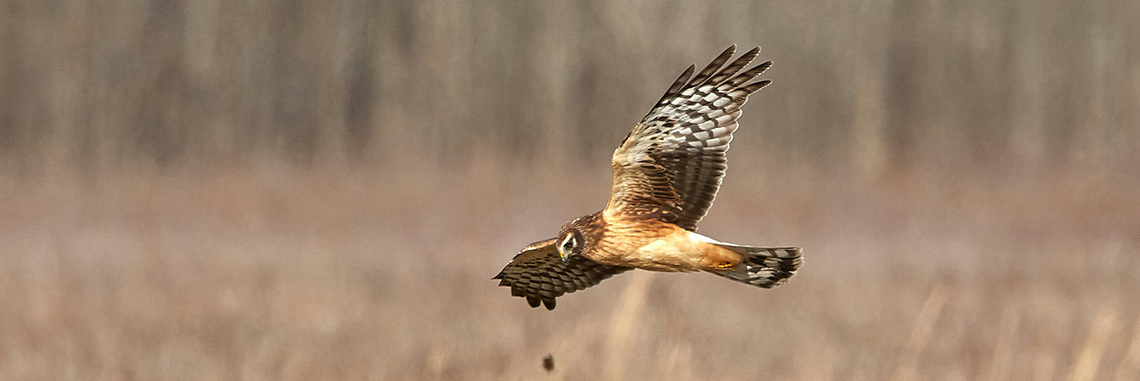
Montagu’s harrier flying over a field
What really makes this species stand out is its plumage. The male sports a gorgeous ash grey colour, black wingtips, and a white chest with delicate brown streaks. The female, with her mottled cream and brown plumage, is far less striking, as are the juveniles, who display a relatively uniform reddish-brown colour.
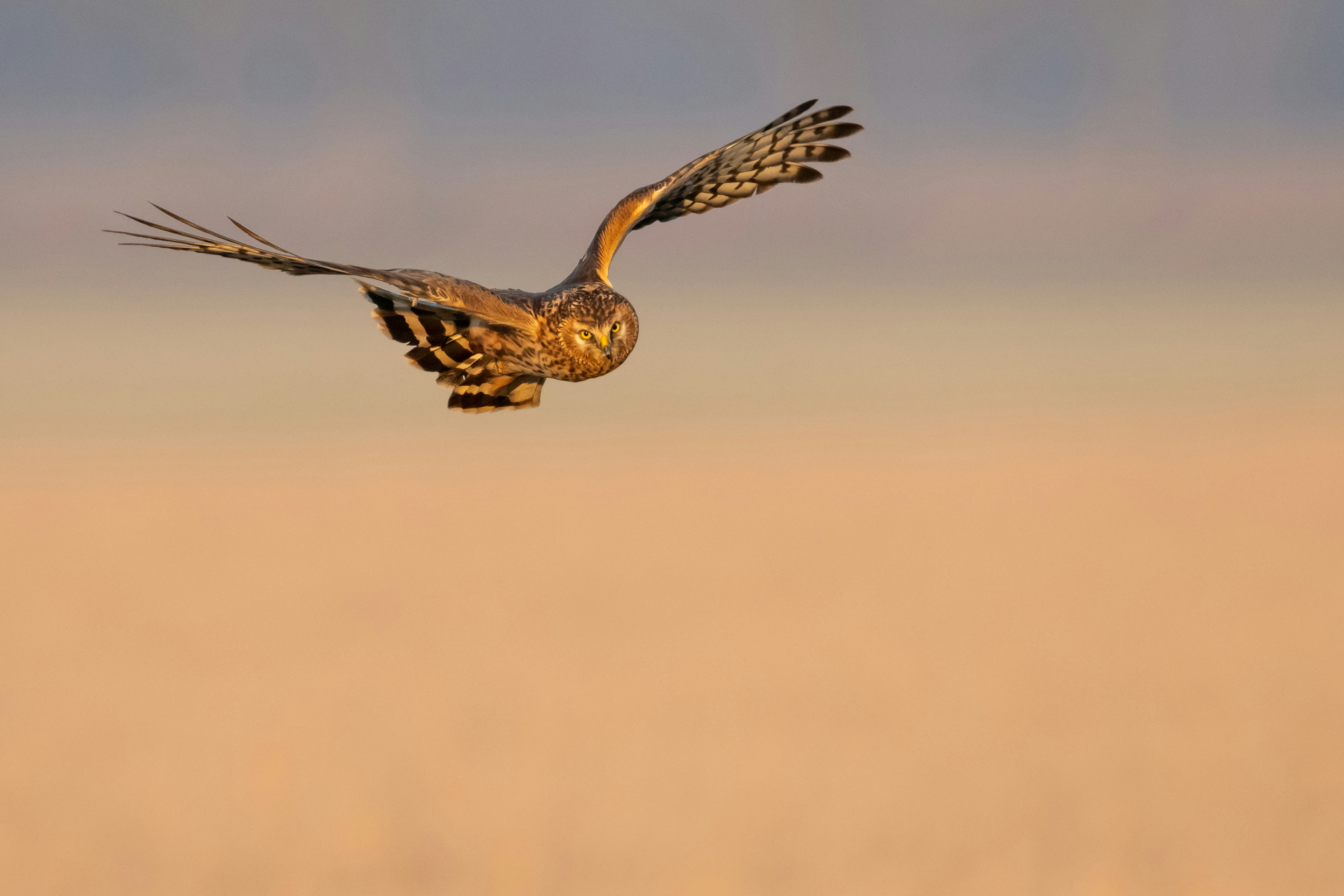
Completing its small head is a short, hooked bill and very lively yellow eyes. Like all harriers, the Montagu has a light, graceful flight, staying low and swaying like a kite in the wind above the grain with its very long, narrow tail and wings. It is about 40 centimetres long and has a wingspan of about a metre.
Thanks to these attributes, the Montagu’s harrier is particularly good at hunting on the ground and in low flight. Given its wing design, the raptor can hover over the fields, even grazing the top of the grains with its talons. Alternating short stretches of gliding flight with bursts of vigorous wing beats, the bird keeps its eyes fixed on the ground to spot its prey.
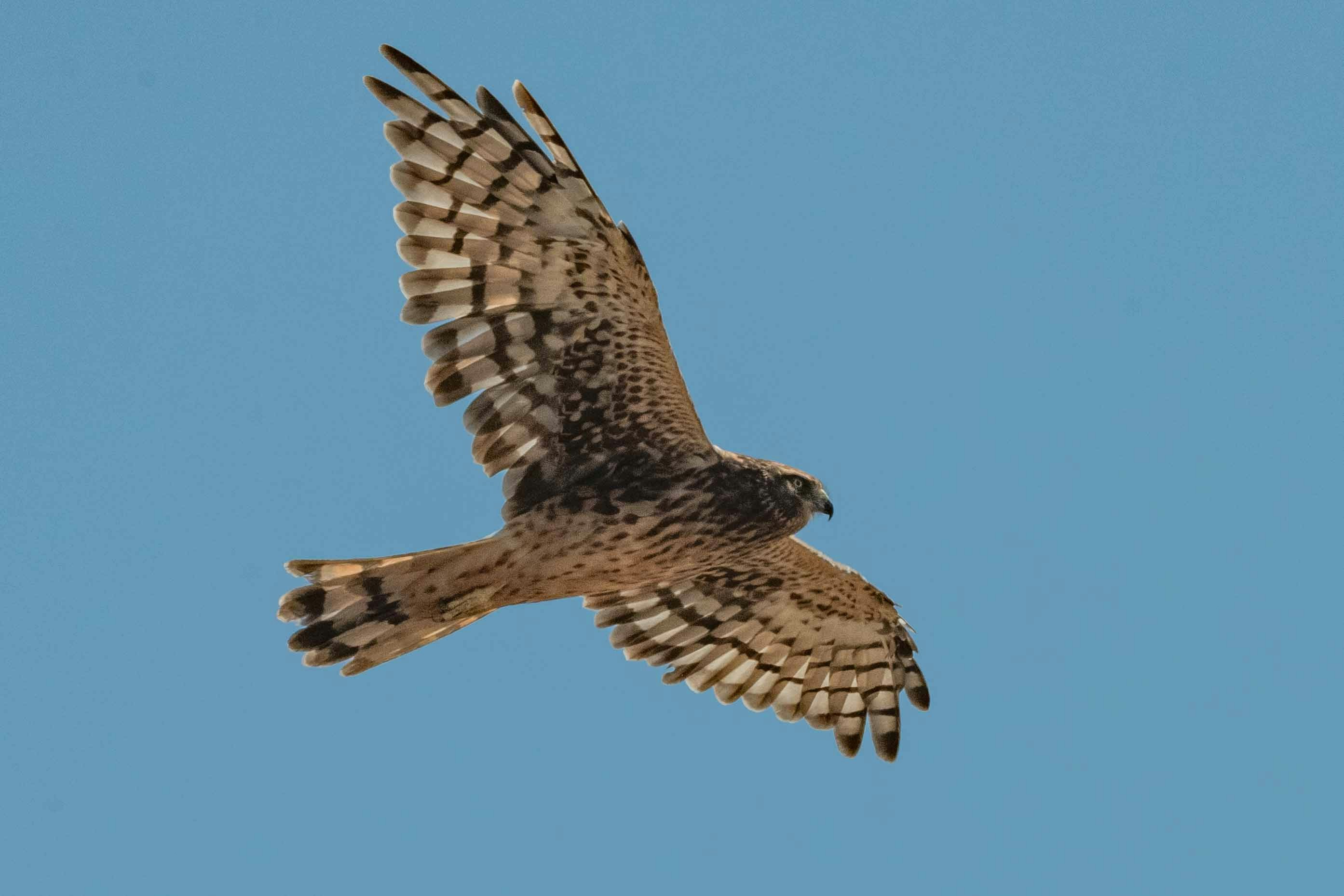
Montagu’s harrier
Its legs – slim, with long talons ending in fine nails – are especially apt for catching voles and field mice, which comprise the bulk of its diet along with grasshoppers and locusts. This makes the raptor a great asset for farmers in terms of pest control. It also catches grassland birds (larks, buntings, corn buntings, and others) and all sorts of reptiles, from small lizards to snakes.
Montagu’s harriers limit their area of distribution to a very specific habitat: cereal fields. If their distribution area lacks this type of territory, they will adapt to fallow land and grasslands of all kinds, from alpine meadows to marshes. In Spain, Montagu’s harriers can be found across the peninsula, albeit in very different numbers. Half of the population is concentrated in Castilla y León, whereas the bird is rarely seen along the Cantabrian coast and in the southeastern regions of Spain. Harriers do not frequent the Balearic or Canary Islands.
Generally, a solitary creature that is difficult to spot, Montagu’s harrier is an elusive raptor, cautious and not at all gregarious in its habits. Until the mating season, that is. During this time, in early April, the harrier performs one of the most spectacular mating rituals among all birds of prey. It consists of varied displays of aerial acrobatics, alternating astonishing nose-dives and spirals, often in pairs, talons colliding, with one bird flying upside down. A show that is well worth seeing.
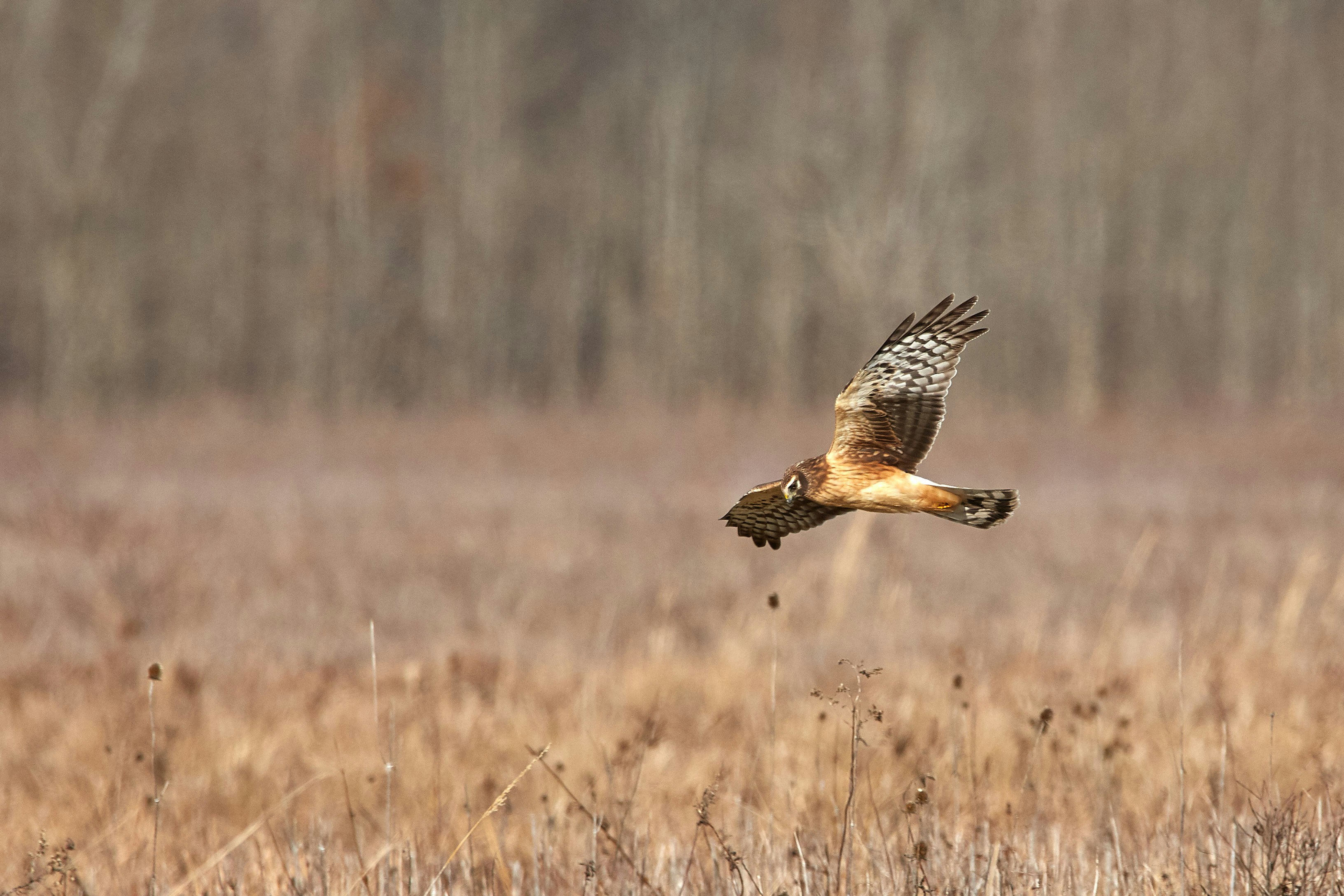
Montagu’s harrier flying over fields
The main conservation issue facing this beautiful, delicate species is its particular habit of nesting on the ground, without any kind of structure, simply leaving the eggs hidden among the wheat without a protective barrier. This exposes the chicks to attacks from a wide range of enemies, from snakes to martens, weasels, and foxes. But that’s not all.
The use of pesticides and, even worse, poison in crop fields poses an enormous threat to all species that live in agricultural environments, including Montagu’s harrier. In the particular case of this raptor, its biggest enemy are the enormous combine harvesters that begin to cut down the fields in late May and early June, when the harrier chicks are still on the ground and not yet able to fly and escape the machine’s terrifying blades.
Given this direct threat, some conservation groups like SEO/BirdLife, which focuses on protecting birds and their habitats, conduct intensive monitoring campaigns aimed at Montagu’s harrier populations during this time of year. This involves locating and indicating their nests in cereal fields so that they are visible to the drivers of the harvesters.
As a result, and thanks to the collaboration of farmers, these groups manage to save hundreds of chicks of this rare and endangered species – included in the Catálogo Español de Especies Amenazadas (Spanish List of Endangered Species) and the Libro Rojo de las Aves de España (Red Book of Birds of Spain) – every year. The most recent census counted fewer than 5000 pairs in all of Spain, amounting to a 30% drop over the past decade.