
The Iberian Magpie and the Vineyard
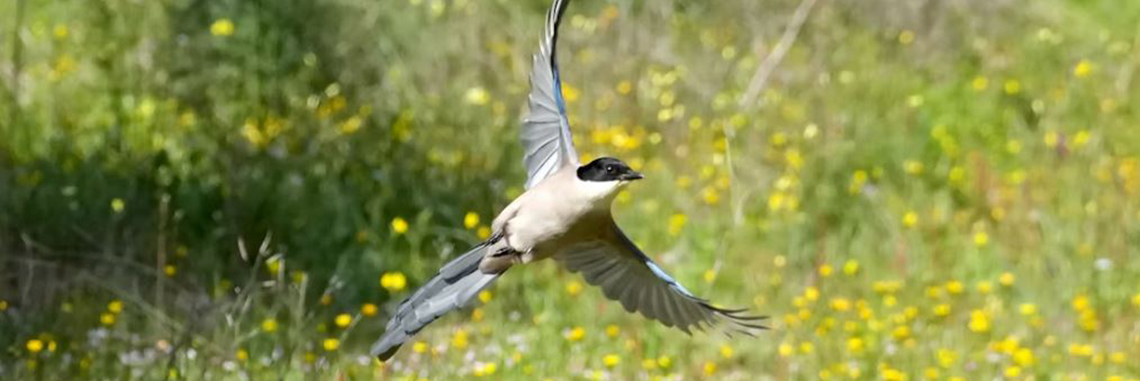
By Jose Luis Gallego, environmental communicator (@ecogallego)
The Iberian magpie is one of the most exotic birds on its namesake peninsula. This small forest-dwelling corvid boasts a long tail – inspiring its Spanish name, rabilargo – that far exceeds the size of its body. The long tail feathers are a beautiful, delicate sky blue, an elegant hue that reappears along the wings and combines perfectly with the back and lower body, which are a creamy brown colour with subtle pink nuances.
The head features a striking black hood that descends to the cheeks, right below the eyes, standing in stark contrast to a snow-white throat. The bill is long and sharp, ideal for hunting insects, and matches the black of the legs.
The Iberian magpie resembles the Eurasian magpie in its flight silhouette and behavioural patterns. In fact, its scientific name, Cyanopica, literally means “blue magpie” since the common magpie’s Latin name is Pica pica. That said, it is far smaller and more slender: measuring 34 cm in length, it has a wingspan of just 40 cm and weighs little more than 70 grams.
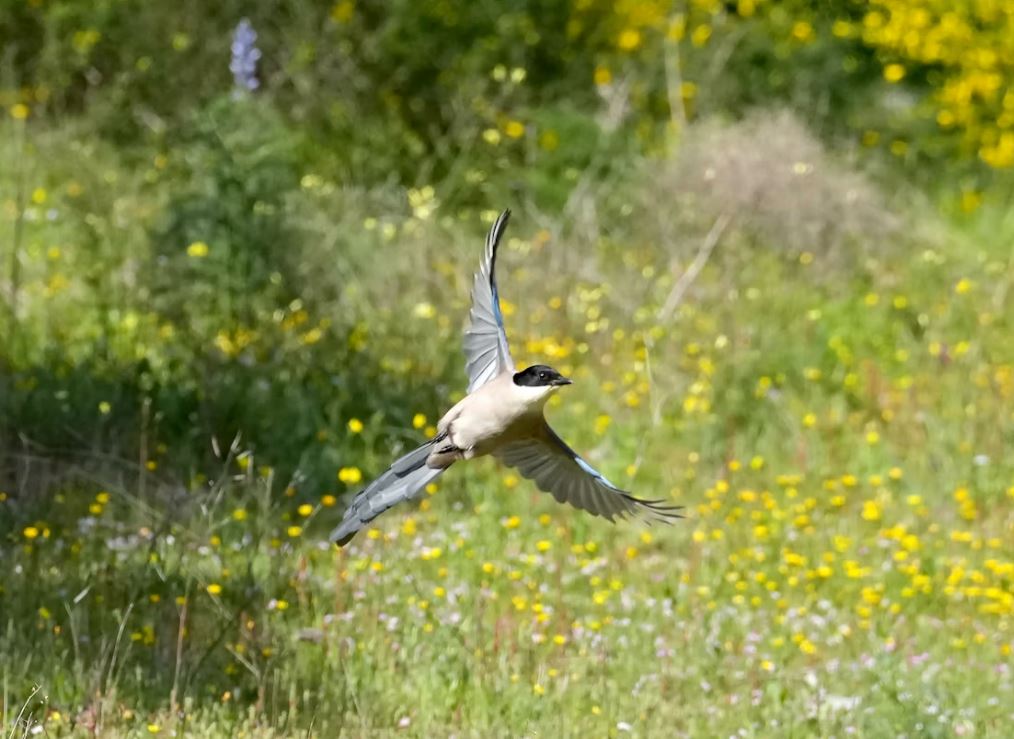
An Iberian magpie Photo: Jacek Urbansk (Unsplash)
Iberian magpies are also far more gregarious than jays and Eurasian or common magpies – they are almost never seen alone. A flock of Iberian magpies constitutes a veritable collective with a sophisticated social network in which each individual fulfils its own curious role: the guard or lookout, for instance.
When moving from one place to another, one bird will take up position at the top of a tree to survey the terrain while the others feed. The guard’s mission is to keep an eye on the surroundings and warn the others at the first sign of danger with a distinctive call: a raspy screech, instantly repeated by the others, that mobilizes the flock to leave the area.
In terms of the species’ distribution in Spain, it is clearly divided in two. The Iberian magpie has its territories in the centre and southwest of the peninsula and is particularly abundant in Extremadura, western Andalucia, Madrid, and parts of both Castillas.
By contrast, the species is nowhere to be found in the north and east, most of Andalucia, and on the Balearic and Canary Islands. Seeing an Iberian magpie in these parts is impossible, because it is a very sedentary, territorial bird that never travels beyond the limits of its distribution area.
It is precisely in this aspect – the location of its nesting grounds – that we can observe yet another curious attribute of this species. On a global scale, Iberian magpie populations only inhabit two geographical areas, separated by thousands of kilometres: the Iberian Peninsula and northeastern Asia.
Ornithologists have invested great effort into finding an explanation for such an incomprehensible distribution on the world map. How did these birds come to Spain? This was the big question for years. Were they brought over by ship centuries ago as exotic birds to adorn the palace aviaries of the Spanish court?
Today’s advanced systems to study genetics, however, have managed to provide an answer by showing that Iberian and Asian magpies are actually two different species: Cyanopica cooki and Cyanopica cianus.
Iberian magpies aren’t fond of damp, dense forests and prefer to dwell in holm oak, juniper, and other open woodlands in dry climate areas, where their diet essentially consists of insects, seeds, and wild berries. They also have a weakness for ripe cultivated fruit, such as figs, cherries, plums, and top of the list, grapes.
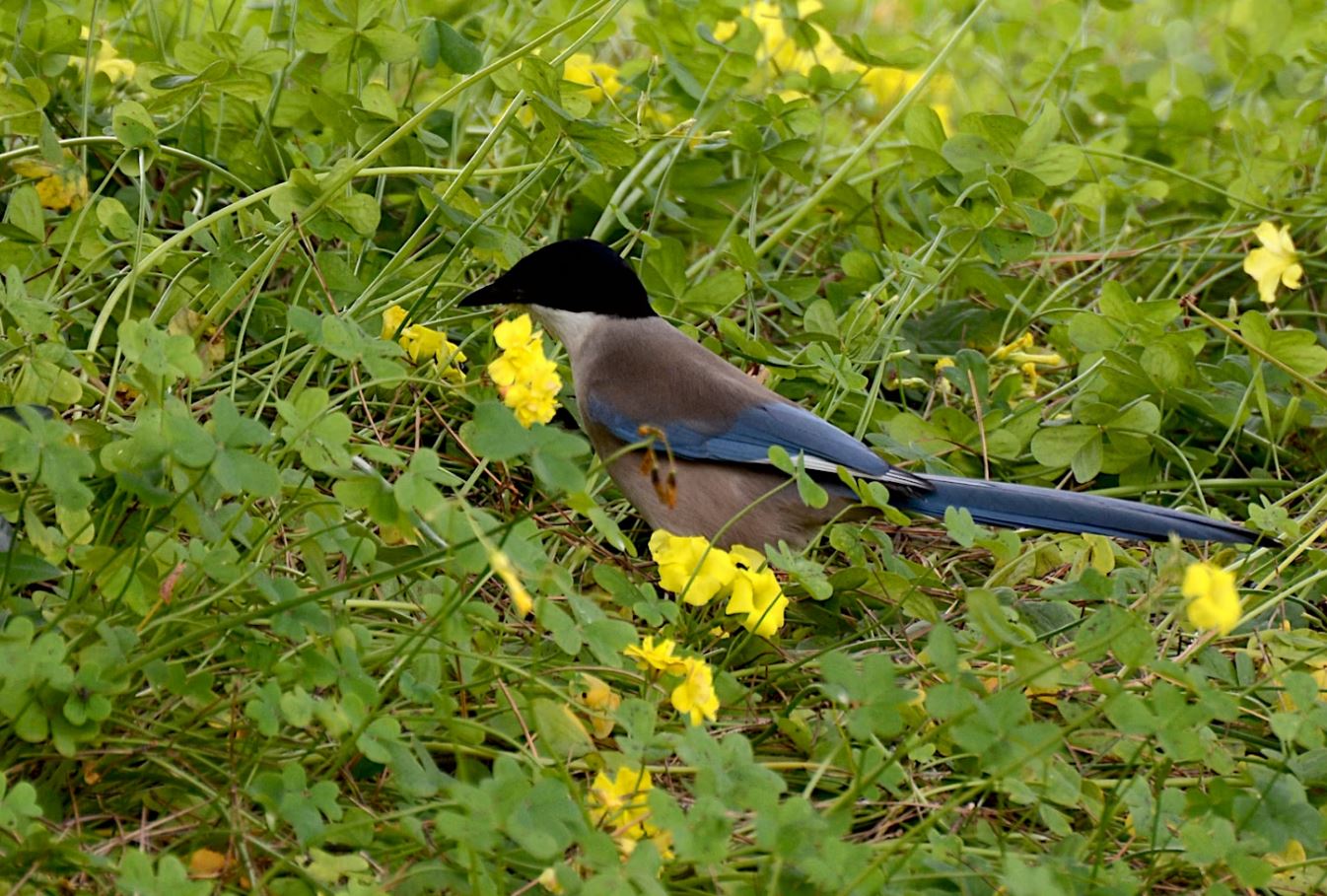
Iberian magpie Photo: Jacek Urbansk (Unsplash)
As a result, Iberian magpies can cause trouble in the vineyard in the days leading up to the harvest when the vines must seem like a feast to these birds. In recent years, the number of complaints has risen in winegrowing areas that overlap with Iberian magpie territories, coinciding with an increase in wildfires.
Apparently, the vineyards become a refuge for Iberian magpies and other forest animals in search of food. Driven by growing frustration among winegrowers, farming unions have demanded financial assistance for those affected, arguing that these elegant birds have become a pest.
However, conservation organizations defend the co-existence of vineyards and wildlife, and, in the case of the Iberian magpie, they are quick to point out the vital services that the bird provides in terms of controlling pests such as woodlice, beetles, and grape leaf beetles, which this gorgeous corvid considers delectable treats.