
The Bohemian Waxwing, the Bird That Came in from the Cold
By Jose Luis Gallego, environmental communicator
@ecogallego
During very cold winters, when polar air masses settle in northern Europe and temperatures plunge to below zero, living conditions for wild birds become especially harsh. For weeks, blizzards, snow, and ice cause the fields to freeze, the production of berries and wild fruit plummets, and birds struggle to find food.
In a situation like this, the best solution is to flee, seeking out gentler climes in which to wait out the harshest winter and return in spring. Under such adverse conditions, many boreal species – strangers to our landscapes – choose to come south in search of a safe haven. On such occasions, nature gives us the unusual opportunity to observe one of Eurasia’s most fascinating birds: the Bohemian Waxwing.
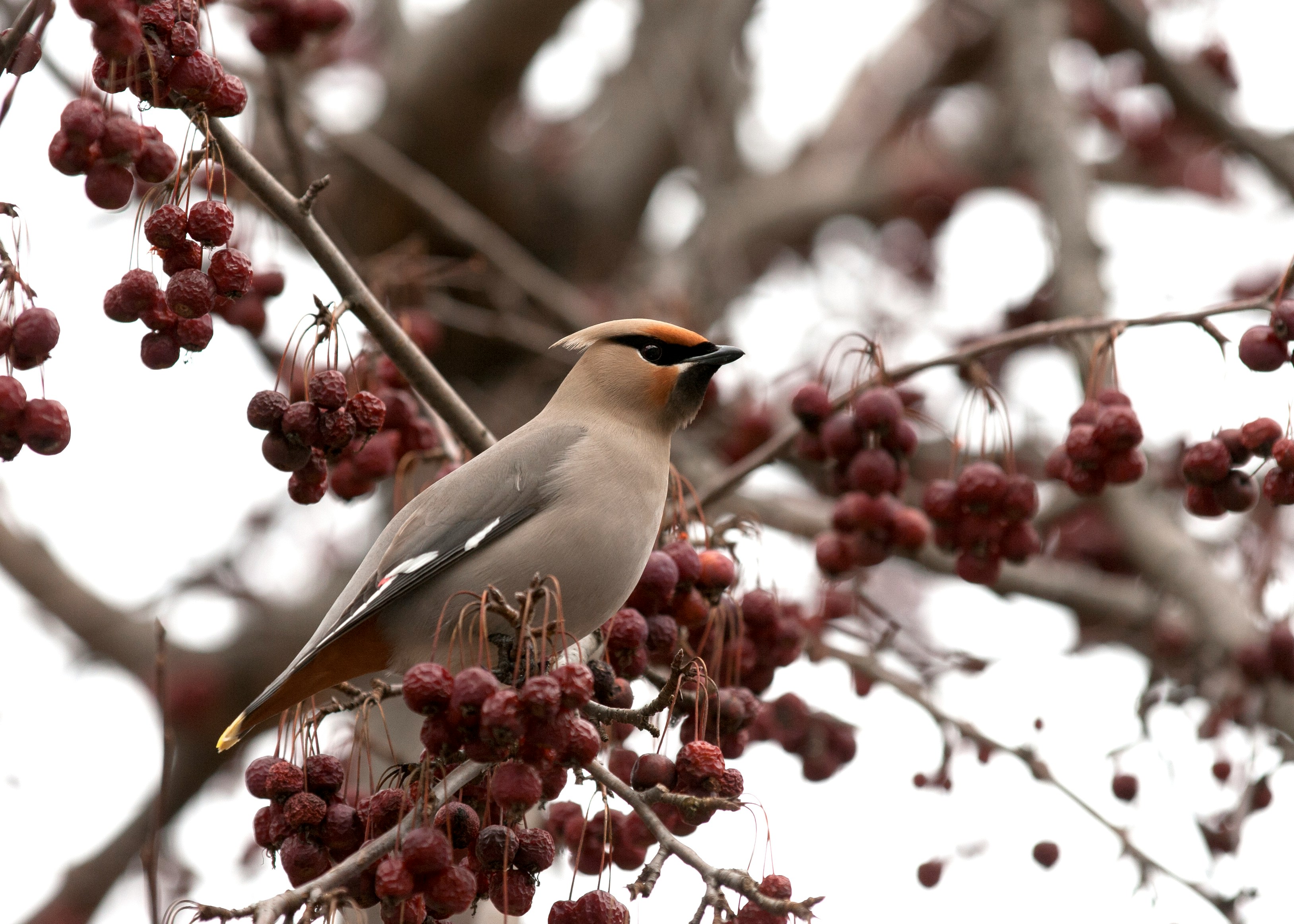
A waxwing perched on a branch
Its appearance is unmistakable. A full-bellied bird, the Bohemian waxwing, which scientists classify under the name Bombycilla garrulus, has elegant stormy grey plumage on the back that turns a subtle brownish grey towards the shoulders. The relatively uniform colouration makes the lemon-yellow tail tip and wing patches even more striking – as eye-catching as a traffic light. The same is true of the bright coral red waxlike tips on the secondary flight feathers.
The chest feathers, much lighter in hue, are almost always downy in appearance, as though made of silk and cotton, which protects the bird from low temperatures. This is why many alpine anoraks are stuffed with down, because it is naturally warming.
The head of the Bohemian waxwing is a wonder: wide and oversized, delicately topped with a swept-back crest. Here the colour pattern ranges from mahogany to peach, contrasting the mask and ruff, both a deep jet black. The eyes are framed by a fine white line around the lower lid. The bill is short and black.
In terms of distribution, Bohemian waxwings are indigenous to the vast forests of birches, firs, and other conifers that extend across the Russian and Scandinavian taiga, where the species keeps its breeding grounds. During the warmer months, the birds even venture into the tundra, the vast region that extends beyond the arctic circle, which turns marshy in summer, enticing a great variety of insects and thereby ensuring the waxwings’ steady food supply during its breeding period.
During the winter, the Bohemian waxwing essentially turns vegetarian and seeks out forests with an abundance of rich, succulent berries – a food it is so fond of that most photos show waxwings with a berry in its bill or perched on one of the bushes that produce them. In the harshest winter, when even this food source becomes scarce, waxwings migrate south, although they rarely go further than the Netherlands, Poland or Germany.
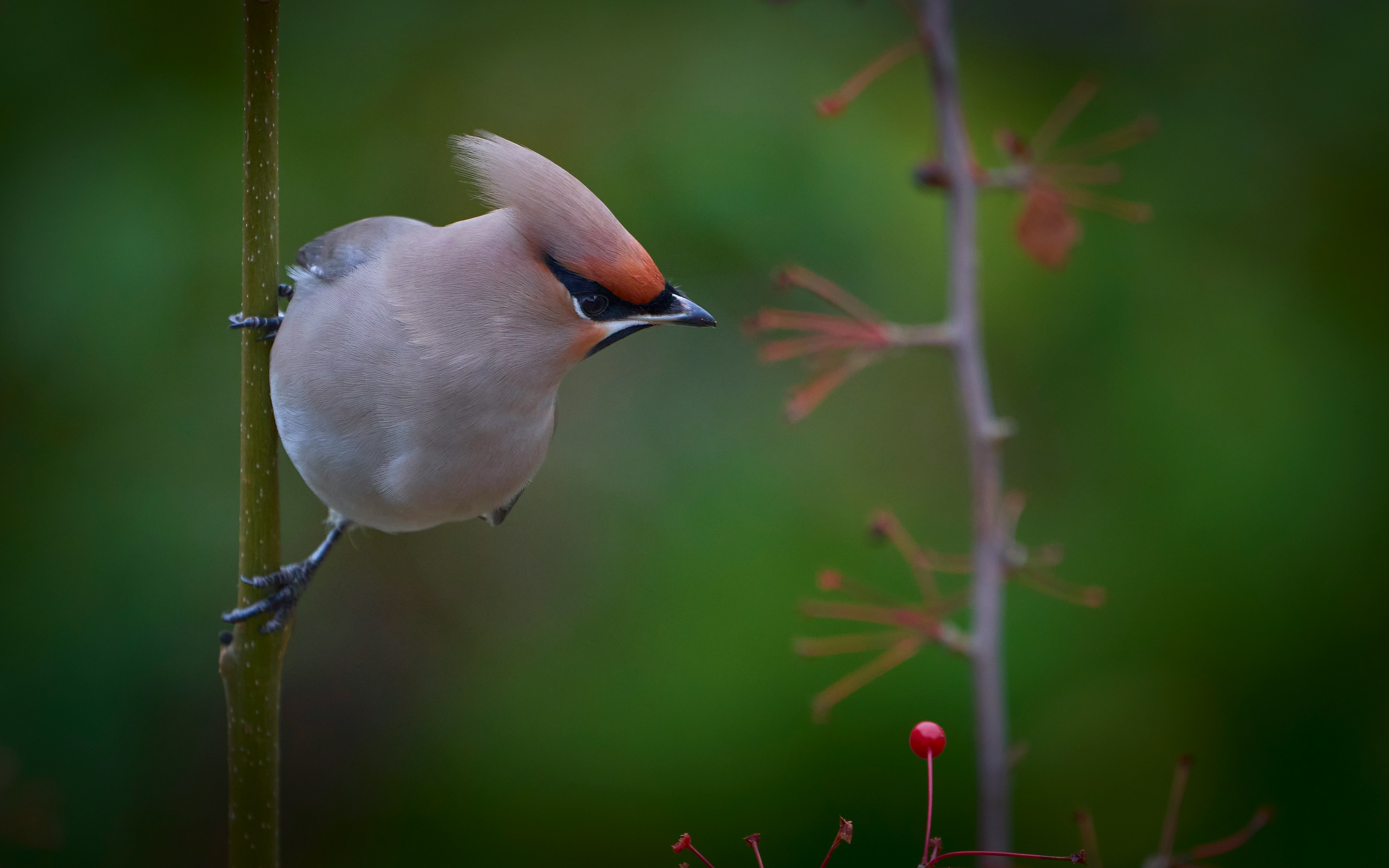
A waxwing on a branch
Only when the winter becomes unbearable in those countries do these gorgeous birds abandon their natural areas of distribution for the Iberian Peninsula. That said, they never go further south than the deciduous forests of the northern peninsula or the parks and gardens of towns and villages in the Pyrenees. Here the waxwings can enjoy tasty sorb, holly, and hawthorn berries, as well as other wild fruit that grow on the trees and bushes of our mountains and valleys – a temperate feeding spot for our northern visitors.
The conservation organization SEO/Birdlife, dedicated to studying and protecting wild birds and their habitats, has observed and recorded several episodes of waxwings arriving in southern France and the northern Iberian Peninsula. In Spain, various waves of waxwing sightings have been documented from the late 1950s to the mid-1960s along the Cantabrian coast and in Navarra, northern Aragon, and Catalonia.
In this century, the arrival of Bohemian waxwings has coincided with the coldest winters, for instance in 2004, when several sightings were reported in parts of Galicia. From 2008 until the present, their visits have been quite consistent, with numerous sightings in Castilla y León, Asturias, and Cantabria. This is why we wanted to open this chronicle with the title The Bird That Came in from the Cold: paraphrasing the celebrated John le Carré novel published in 1963, which happened to be the year Spain experienced unusually heavy snowfall.